Farming Paradise Island in Charleston, SC — the numbers | ListHook
Paradise Island · Charleston, SC · 319 single-family homes
1 of 1 · Open
24 homes sell in Paradise Island a year.
On these numbers the agent farming it should list around 1 a year, assuming we win 2% of the homes that turn over. Right now, that agent is nobody.
I
The napkin math
Single-family homes319
Sold last 12 months7.5% turnover — steady, not boom-bust24
Median list price$1.3M
Your estimated listings a year, farming it1
Every one of those sales is a listing, and it goes to whoever the neighborhood already knows. When one of them is yours, the $38K is yours too — no fee at closing, ever, and no share of it to us.
II
How Paradise Island compares
We have graded 342 neighborhoods in Charleston, SC. Here is where Paradise Island sits among them.
277th largest of 342 — a typical Charleston, SC neighborhood here has 642.
319
Turnover
60th fastest of 342 — the midpoint across this market is 4.3%.
7.5%
Median list price
32nd highest of 342 — the midpoint here is $453K.
$1.3M
Paradise Island is small and it moves. A neighborhood this size gets to seven touches on every owner faster than a large one does, and there is enough turnover in it to be worth owning while that happens.
The agent, the brokerage and the neighborhood printed on this card are a sample. We won’t mock one up with your name on it before we’ve built your list — what you’re looking at is the real print file: the layout, the trim, and the words that go to press.
Front
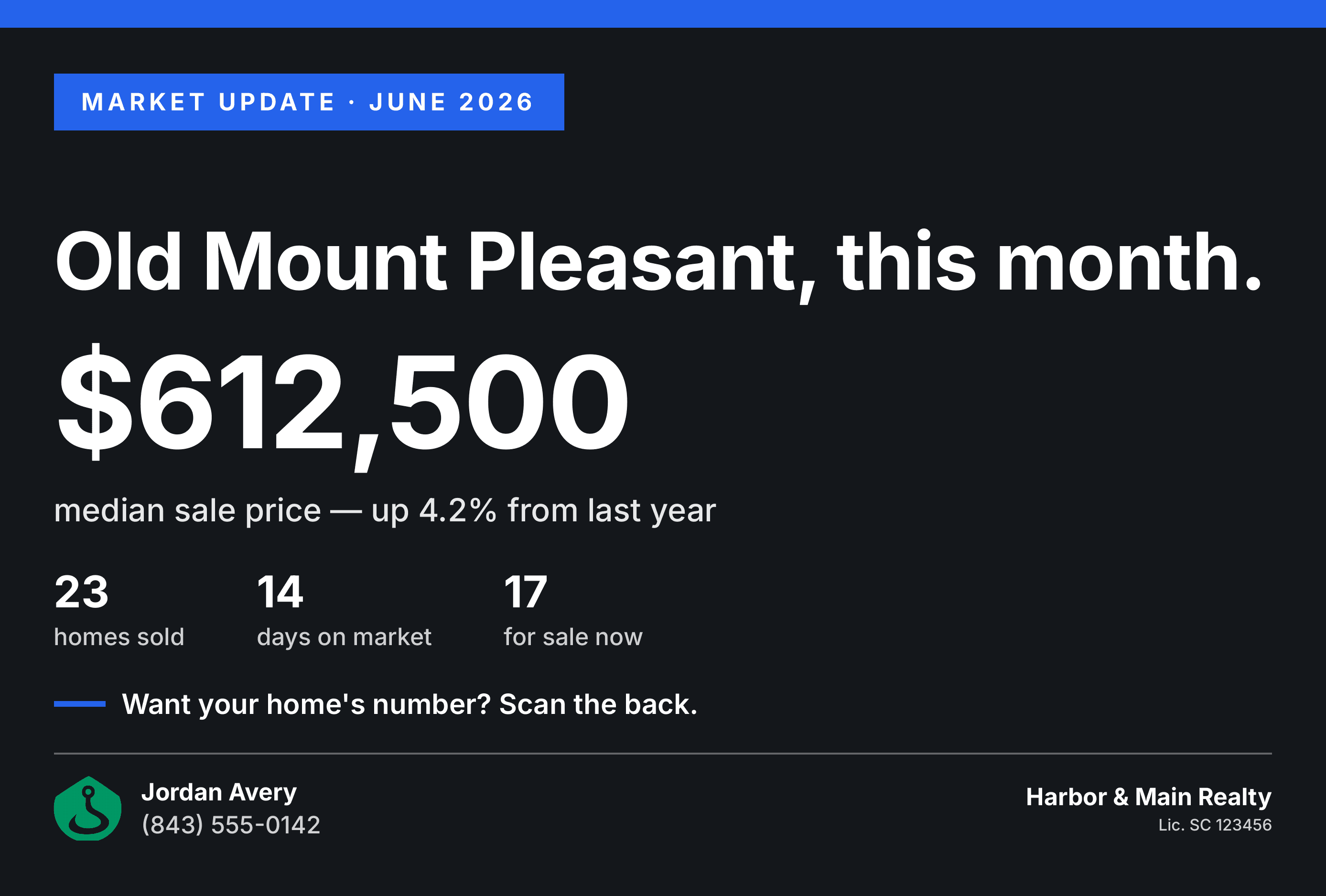
The front is the monthly card. On yours it carries Paradise Island in the headline and that month’s real numbers for it — the same figures this page is built from — over your name, your phone, your brokerage and your licence. Ours is nowhere on it.
Mail face
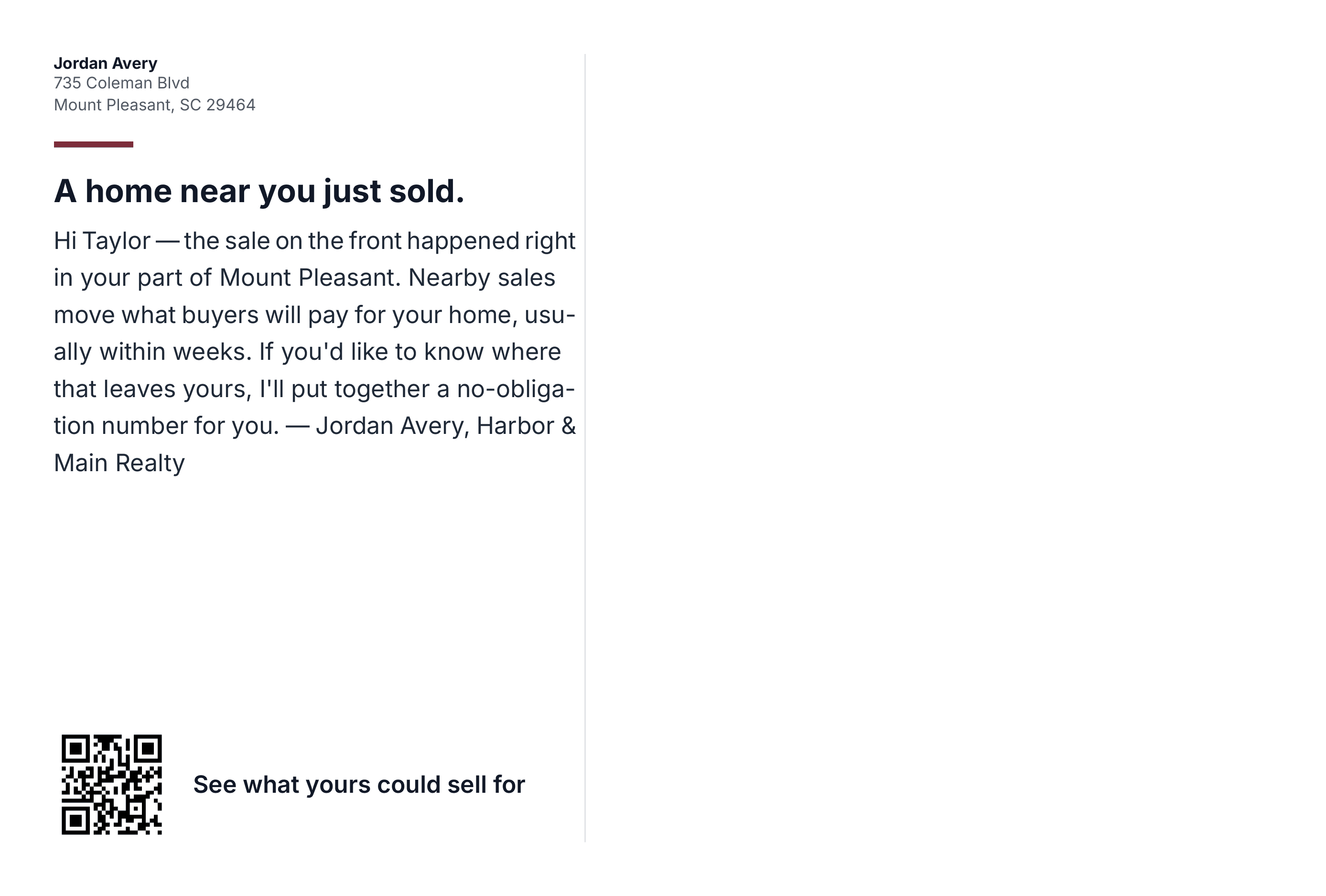
The mail face carries your return address, a short note signed by you, and a QR that opens a page under your name. The right half stays clear: the owner’s address, the postage indicia and the barcode are applied per piece at the press, so they aren’t in the design file.
IV
The first mailing
If you signed today
First mailing
Then
… 12 months
The first of every month, whether it was a busy month for you or not. You don’t approve anything, and there is no month where the card doesn’t go.
If we ever miss a month, that month is free. That’s a term, not an adjective — an absolute promise is only worth what happens when we break it.
Nothing is queued for Paradise Island today — no agent holds it, so there is nothing to be running. That date is counted from today: we take about 10 days between a signature and a press run to build the mailable list, pull the just-solds, and put a proof of your card in your hands.
V
Who gets a card, and who doesn’t
Every single-family home in the neighborhood
319
Not a slice, not a scored shortlist — you can't be the agent a neighborhood knows to a shortlist.
Condos, apartments and multi-family
We mail single-family detached only. It keeps the card addressed to someone who owns the roof, and it keeps the numbers on this page honest — they describe the same homes we mail.
Homes that just sold
A just-sold owner isn’t moving again, and a "thinking of selling?" card two weeks after they closed is how a whole neighborhood decides your mail is automated. They come off the run before it prints.
What that does to your price: nothing
Your number is set once, from the neighborhood’s single-family count. Pulling a just-sold off a run doesn’t discount it and it isn’t billed by the piece — so nobody has to argue about a count at the end of the month.
VI
You hold it. We farm it.
The card is yours, not ours
Written, printed, and posted for you, in your branding. You never touch a mail house.
Sellers call you, not us
Every reply — scan, call, reply card — routes straight to your phone.
VII
Two promises
Built for a Full Year
Farming compounds — we only take agents committed to 12 months of consistency. Pay for 12 months and don’t get a listing that pays for your entire contract? We mail free until you do. Two conditions: complete the full 12 months, and respond to routed leads within 24 hours.
No Fee at Closing — Ever
Founding agents keep every dollar of every commission. No split, no referral fee. Locked for life, in writing.
We ask for the full twelve months because that’s how long a neighborhood takes to pay back — and if you ever absolutely need to stop, just let us know.
VIII
Why this works
Marketing the way it used to work: pick one neighborhood, show up every month, become the agent the whole neighborhood thinks of. We do the showing up.
01
Postcards get read
NAR research backs what 25 years of real-estate publishing shows: physical mail gets opened, read, and kept in ways digital never is.
02
Seven touches build the name
Familiarity compounds. By the seventh card, owners know your name before they ever need an agent.
03
Top of mind takes the listing
Sellers rarely shop. When it’s time to list, the overwhelming majority call exactly one agent — the one they already know. Farming makes that you.
04
Signals, not spray
Context-aware signals — a sale nearby, long tenure, high equity — shape each card, so it speaks to the owner's situation instead of a generic "thinking of selling?"
Any one of these helps. Stacked, they compound — and the estimate above is a starting point, not a ceiling.